
SwapCut
Redesigned AI hairstyle preview flow, cutting onboarding friction and lifting subscription conversions.
Overview
Parallel Distribution brought me in to redesign SwapCut's core flows (onboarding, style browsing, and subscription conversion) in a fast-paced, iterative contract engagement. The product uses AI image generation to preview hairstyles on a user's photo.
The Challenge
How might we help individuals confidently explore and choose new hairstyles, reducing uncertainty and miscommunication while enhancing their overall salon experience?
Process
Reviewed session recordings and exit surveys to identify the highest-friction points in the existing onboarding and style-selection flows.
Mapped the key drop-off moments: a long mandatory question set, costly per-tap image generation, and a subscription paywall with weak value framing.
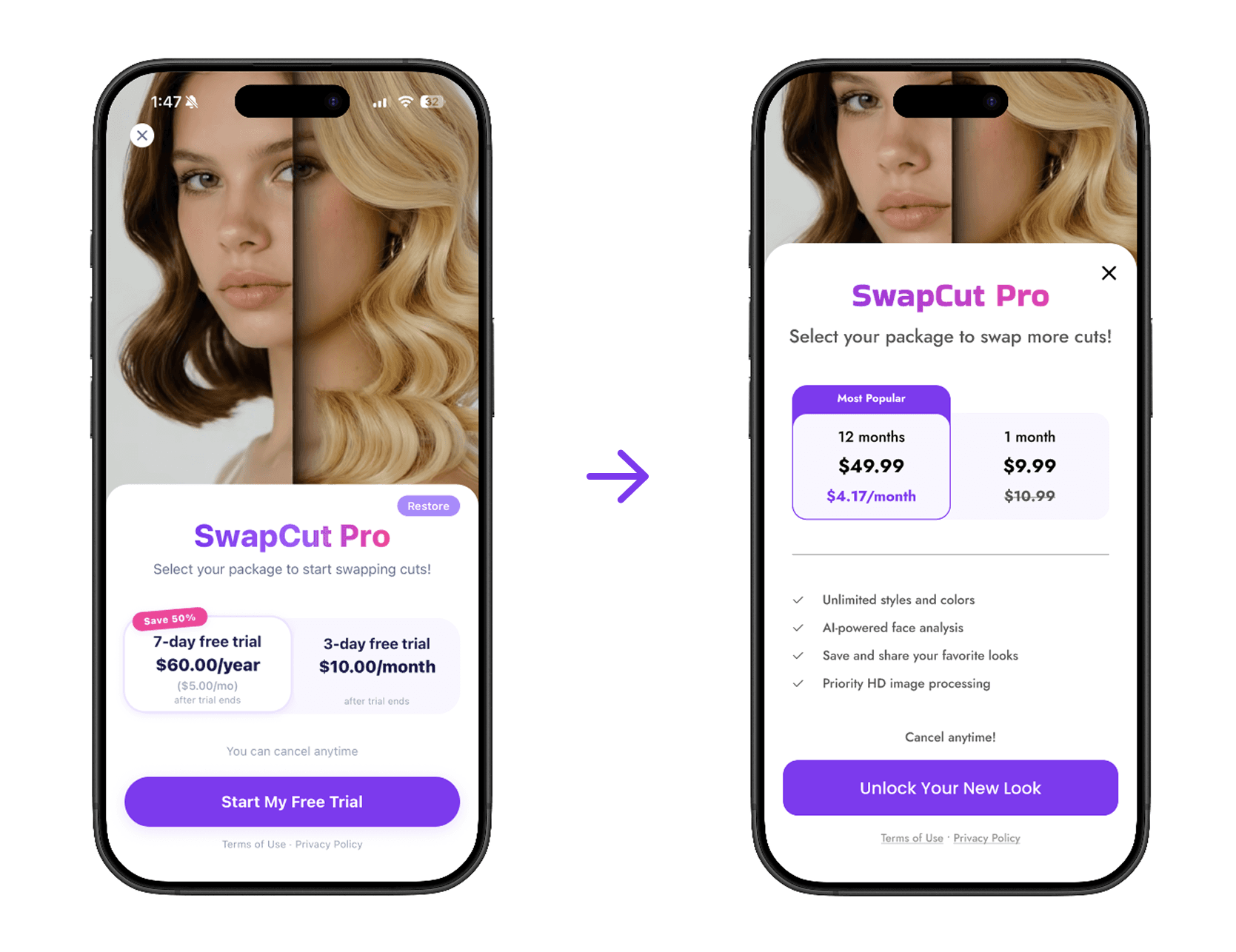
Redesigned onboarding to be optional and GIF-driven. Introduced model preview before photo upload to cut generation costs. Prototyped 3 subscription UX variants for A/B testing.
Ran A/B tests on price model, UX writing, and microcopy. Iterated rapidly based on conversion data from each release cycle.
Outcomes
Design
Onboarding
In the first iteration, users were required to answer a long series of questions. Now, after answering some optional questions, the user is guided through how the app works with captivating looped GIFs and short descriptions.
Browsing Styles
Users have the option to preview hairstyles on a model before applying the hairstyle to their uploaded photo. Previously, users would generate a new style when selecting the style's image card. This method significantly cut costs on image generation.
Further Hairstyle Insights
Users can receive precise, technical hairstyle instructions to easily share with their stylist. They can also view their hairstyle from 4 different views, simulating a 360 degree view of their new look.
A/B Testing: Subscription UI & Price Model
By experimenting with price models, UX writing, and microcopy, we were able to convert more users to subscribers.
Key Learnings
Designing effective UX/UI solutions required clear and intentional communication throughout each iteration. Even small details in documentation and handoff can significantly influence how developers interpret and implement a design.
This experience reinforced how closely UX decisions are tied to business outcomes. By redesigning friction points, I helped streamline the experience while contributing to measurable cost reductions across new user accounts.
Instead of relying solely on extended upfront research, we used insights gathered from each release cycle to identify usability issues and prioritize improvements through rapid design sprints.